
This page addresses the following distinctions:
- The distinction between public jurisdiction and private jurisdiction.
- The distinction between rights administered through governmental systems and birthright arising from natural existence.
- The distinction between legal-administrative identity and natural personal identity.
- The distinction between statutory frameworks and principles of personal sovereignty, responsibility, and self-governance.
- The distinction between governmental registration systems and voluntary private recordation such as FRRf.
Understanding the Distinctions
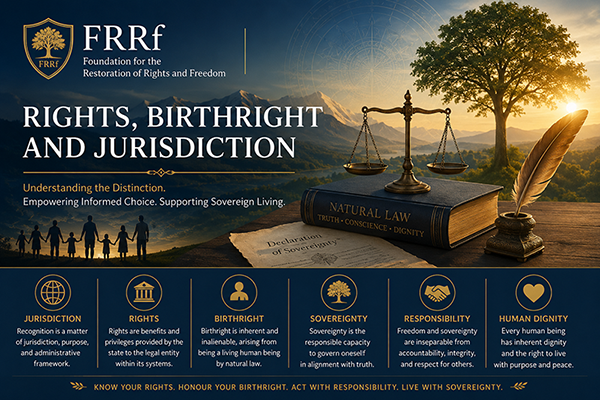
FRRf encourages individuals to explore the distinction between rights, birthright, personal responsibility, and the various jurisdictions that operate within modern world systems.
The foundation recognises that different institutions, systems, and communities often operate according to different frameworks, purposes, and sources of authority. Understanding these distinctions can help individuals make more informed decisions regarding their personal affairs, responsibilities and administrative processes.
A Question of Jurisdiction
FRRf views many questions concerning recognition, authority, and administration as matters of jurisdiction rather than matters of universal obligation.
Public institutions generally operate within governmental and statutory frameworks. Private organisations, associations, trusts, and registries may operate within separate private frameworks established by their members, participants, or governing instruments, such as FRRf.
As a result, recognition is often determined by the jurisdiction, purpose, and administrative framework within which a document or instrument is presented.
For this reason, FRRf encourages individuals to understand that different systems may apply different standards of recognition and administration according to their respective functions and responsibilities. In other words, one system does not automatically recognise the other system, administratively.
Rights and Administrative Status
Within modern governmental systems, many rights, benefits, privileges, protections, licences, and administrative services are administered through recognised legal identities maintained within public record systems, applicable to registered entities. Birth registration serves as a foundational example of this process, creating a legal-administrative record through which governmental systems identify and administer rights, responsibilities, and public functions in relation to the individual.
These systems provide a framework through which governments organise public administration, citizenship, taxation, licensing, property registration, and related functions.
Individuals who choose to participate in these systems may receive benefits, protections, opportunities, and responsibilities associated with those administrative structures.
FRRf encourages individuals to understand both the advantages and responsibilities associated with participation in such systems.
Birthright and Natural Existence
In addition to administrative rights, FRRf recognises the concept of birthright.
Within the foundation’s educational framework, birthright refers to those aspects of existence that arise naturally from being a living human being.
Examples commonly associated with birthright include life itself, human dignity, conscience, personal development, self-determination, the pursuit of knowledge, peaceful association, and the ability to seek food, shelter, and wellbeing.
These principles are often discussed within natural law traditions, philosophical traditions, spiritual teachings, and human rights discourse.
Sovereignty and Responsibility
FRRf teaches that sovereignty is inseparable from responsibility.
Personal sovereignty is not merely a question of rights or freedoms. It also involves accountability, integrity, self-governance, respect for others, and consideration of the consequences of one’s actions.
The foundation encourages individuals to cultivate wisdom, self-discipline, ethical conduct, and service to their communities.
Living Individuals and Administrative Systems
FRRf’s educational materials explore the relationship between an individual’s natural identity and their legal-administrative identity, while recognising that these are distinct jurisdictions, each operating according to its own framework, standards, principles, and administrative procedures.
The foundation encourages individuals to understand how administrative systems function, how legal identities are recorded and maintained, and how those systems interact with the daily lives of living individuals.
This educational approach is intended to promote informed participation, personal responsibility, and greater awareness of the structures that influence modern living.
Our Educational Mission
FRRf is an independent educational and registrar institution operating in a private capacity, supporting sovereignty education, personal responsibility, and private registration.
The foundation’s role is to encourage learning, understanding, and informed choice. Individuals remain responsible for their actions and interactions within the communities, jurisdictions, and legal systems with which they concurrently engage.