


Introduction to FRRf’s Full Framework – the cLPT
The common Law Pure Trust (cLPT) is a private trust framework historically used to structure governance, estate control & management, and to organised private agreements, documentation & certification processes.
While these mechanisms were foundational in earlier systems, their structure and application are no longer widely understood.
The cLPT provides a direct approach to private trust formation, enabling a man or woman to define their relationship to their estate within a clear and intentional structure.
Access to this structure is provided through the Sovereignty Certification and Estate Management package.
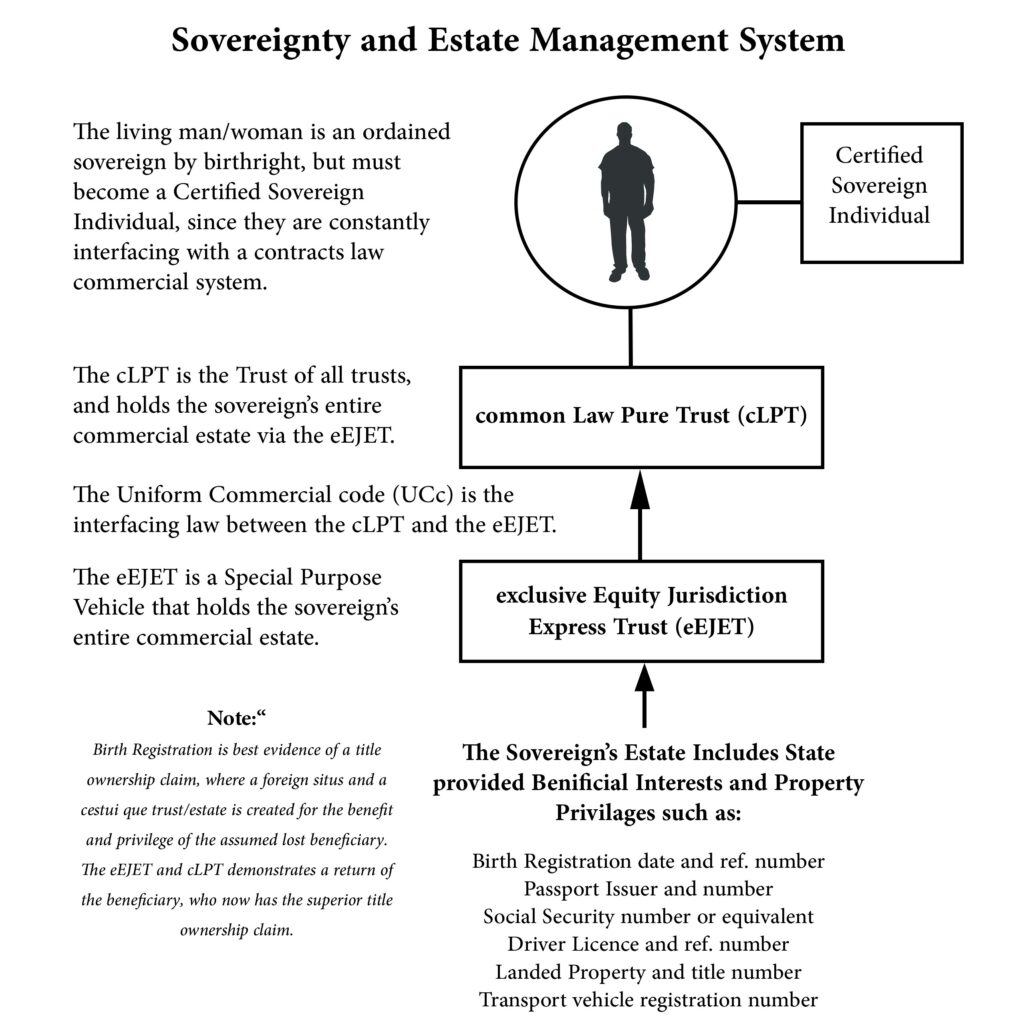
Function of the cLPT
The cLPT is designed to establish a private trust arrangement through which a man or woman may position and engage with their estate, land, and associated assets.
Within this arrangement, the relationship to such assets is defined by role and function rather than conventional notions of ownership. The participant operates in a managerial or administrative capacity, in accordance with the terms and provisions of the trust.
The language and structure of the cLPT are critical, as they determine how the trust is formed, interpreted, and maintained over time. Proper alignment ensures clarity of roles, responsibilities, and scope.
Through this arrangement, the participant engages with their estate from a defined position within a private trust, rather than through informal or undefined obligations.
Positioning and Engagement
The cLPT provides a method of structuring one’s relationship to assets in a deliberate and organised manner.
This positioning does not rely on assumptions of ownership, but instead on clearly defined roles established at the time of trust formation.
All engagement with the estate is conducted within the terms and provisions of the trust itself.
Scope & Orientation
This section outlines how the arrangement is structured and engaged with, providing context for its application.
The cLPT operates as a private arrangement existing alongside external legal and governmental systems. Its function is governed by the structure it establishes and the roles defined within it.
Participants are responsible for understanding the scope and defined parameters prior to engagement.
Historical Background
The common Law Pure Trust (cLPT) draws from early trust arrangements that began to form during the medieval period, particularly as mechanisms for managing land, estates, and obligations under evolving systems of governance.
These early arrangements allowed for the separation of control, benefit, and responsibility—principles that remain foundational to trust law today.
Over time, such arrangements were refined into more formal provisions, establishing consistent methods for trust creation, administration, and continuity.
The modern cLPT reflects this lineage, operating as a structured private arrangement built upon these enduring principles, while maintaining its own defined terms and methods of execution.
Certain private lineages and institutions have historically maintained and adapted trust-based arrangements across generations, contributing to the continued evolution of such structures.
Pure Trust certificate (PTc)
The PTc serves as the formal record confirming that the trust formation process has been completed.
It documents the agreement and acknowledgment between the participating parties, and verifies that the trust has been properly established.
Fidelity Ceremony
The formation of the cLPT includes a formal act of agreement known as the fidelity ceremony.
This is not ceremonial or symbolic in nature, but a structured act of mutual recognition and agreement between two parties. It represents the meeting of intent and the establishment of defined roles within the trust.
Through this process, the terms of the trust are acknowledged and accepted, forming the basis for its execution.
Execution of the Trust
Following the fidelity ceremony, the trust is executed through the signing of the Pure Trust certificate (PTc) and any associated documents or acknowledgements.
Execution confirms that:
- The parties have entered into agreement
- The structure of the trust has been accepted
- The arrangement is now active and operational
In practice, only the PTc may need to be completed by the participants at the time of issuance, as certain elements such as the trust provisions may be prepared in advance.
Role of Administration
The administration of the trust is supported by a managing authority responsible for preparing and maintaining its structural integrity.
While participants are encouraged to understand the arrangement, the administrative process ensures that formation and execution are carried out in an orderly and consistent manner.
Special Deed of Trust
The Special Deed of Trust establishes the intent, subject matter, and participating parties of the privately held cLPT.
It defines the structure of the trust and records the relationship between the Exchangor/Grantor and the trust arrangement, including the placement of the defined estate within the trust corpus.
Through this instrument, the terms, scope, and operational boundaries of the trust are formally expressed and recorded.
Trust Declaration
Upon entering the process, the Exchangor/Grantor may issue a Trust Declaration confirming their intent to establish and engage with the cLPT under its defined terms.
This declaration forms part of the overall arrangement and contributes to the formalisation of intent.
Parties to the cLPT
The cLPT is structured through clearly defined roles:
Creator
The party responsible for preparing and establishing the trust instruments, including:
- Pure Trust certificate (PTc)
- Pure Trust provisions (PTp)
- Declaration of a common Law Pure Trust Contract (DcLPTC)
- Associated addenda and supporting documents
Exchangor / Grantor (E/G)
The party who places defined assets or interests into the trust in exchange for the structure, provisions, and instruments of the cLPT.
Trustee(s)
The party or parties responsible for holding and administering the trust corpus in accordance with the terms and provisions of the trust.
Managing Authority
Appointed or designated to carry out administrative functions under the trust, ensuring consistency and continuity of operation.
Contact us here for more information.
Are You ready to Engage?
*** click here ***
NOTE: More detailed trust frameworks, structural documentation, and implementation materials are maintained within the members area.